Time Management for Busy Moms: Simple Systems to Reclaim Your Day
Key Takeaways
- This guide is designed for overwhelmed moms juggling work, kids, home, and their own well being in 2026—perfection is not the goal.
- Build a realistic weekly rhythm that matches your current season of motherhood, whether you have a newborn or school-age children.
- Focus on three core pillars: knowing your “why,” planning your week (not just your day), and protecting energy with rest and boundaries.
- You’ll get concrete, mom-tested strategies like Sunday night planning, 10-minute home resets, and practical ways to involve kids and your partner.
Picture this: it’s 7:15 AM on a Tuesday. You’re packing lunches while answering Slack messages, reminding your oldest to find their shoes, and mentally calculating whether you can squeeze in grocery shopping before the 3 PM school pickup. Sound familiar?
Modern motherhood comes with visible tasks—meals, laundry, doctor visits—and an invisible load that many moms carry alone. You’re the one remembering picture day, tracking which kid needs new sneakers, and mentally scheduling every appointment. Research suggests moms now average 16-18 hours of unpaid labor daily, with working moms reporting significantly higher stress from this mental scheduling burden.
Here’s what matters: time management is a skill you can learn, even when daily life currently feels like constant firefighting. This article focuses on simple, flexible systems rather than rigid routines that break the moment a child gets sick or a meeting runs late.

Start With Your Why: Designing Days Around What Matters Most
Many moms feel like their schedule runs them instead of the other way around. Without clarity on priorities, you’ll say yes to everything and end up exhausted, wondering where the week went.
Try this 15-20 minute values check-in: list your top five priorities (connection with kids, health, marriage, financial stability, faith, creative work) and rank them honestly. This isn’t about what you should value—it’s about what actually matters to you right now.
Consider a working mom with a busy schedule from 8:30-4:30 and two kids in elementary school. Her “why” is family connection, so she protects family dinners at least three nights a week. This becomes her non-negotiable. Other commitments must work around it.
Make your why visible: a post-it on the fridge, a single word on your phone lock screen, or a sentence in your planner. Revisit it quarterly—January 1st, April 1st, July 1st, October 1st—and adjust as your kids’ needs and seasons change.
Know Your Planning Personality (So You Stop Forcing Systems That Don’t Fit)
Not all moms plan the same way. Some love color-coded calendars and detailed to do lists. Others shut down completely when facing too much structure. The key is finding what works for your brain, not copying what works for other moms.
A few planning types to consider:
- The list-lover: thrives on handwritten task lists, crosses items off with satisfaction
- The visual time-blocker: needs to see the whole week mapped out in colors
- The digital app fan: lives in Google Calendar with reminders and notifications
- The big-picture planner: prefers weekly overviews without minute-by-minute details
Notice what you naturally do now. If you scribble notes on envelopes, a simple paper system might work better than a fancy app. A creative mom might love a dot-grid notebook for intuitive sketches, while an analytical mom prefers a structured planner with pre-printed time slots. When you match your tools to your natural style, you’re far more likely to stick with the system.
Set Goals That Match Your Season (Not Someone Else’s)
Traditional goal-setting can feel impossible when you have toddlers or unpredictable shift work. The solution isn’t to abandon goals—it’s to right-size them for your current life.
Pick at most 1-3 goals per quarter that directly connect to your why. Make them specific: “Walk 20 minutes, 3 times a week, with stroller, from March 18 to April 30” beats “exercise more.”
For high-demand seasons (newborn months, exam periods for older kids), go even smaller. A micro-goal like “Go to bed by 10:30 PM on weeknights in May” can make a real difference. Write goals in one consistent place—your planner, a digital note, or a printable—and glance at them during weekly planning to stay on track.
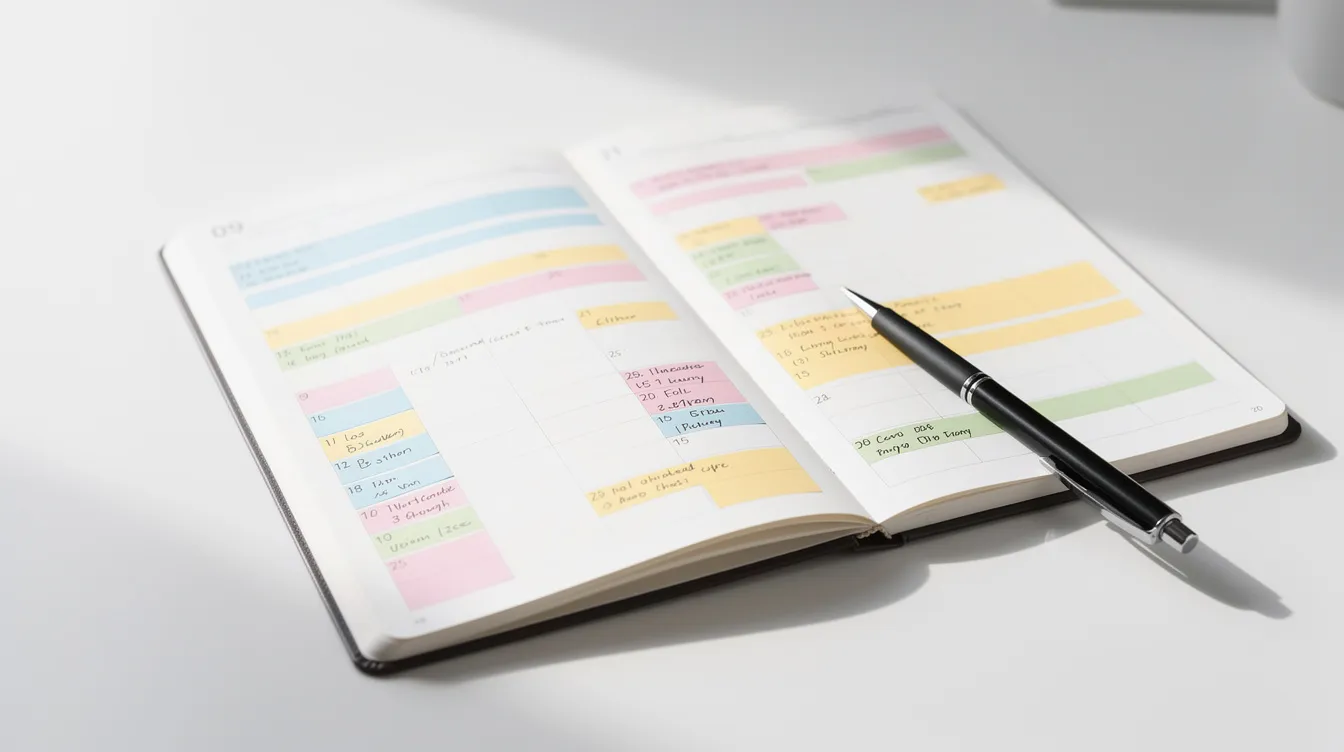
Budget Your Time Like Money: Time-Blocking for Real Moms
Every mom gets the same 168 hours per week. Clarity comes from seeing where those hours actually go. Start with a simple 7-day time log—just one typical school week—to spot patterns and time leaks.
Basic weekly time-blocking divides your day into chunks rather than planning every minute:
- Early morning (6:00-8:00): personal time, breakfast, prep
- School hours (9:00-2:30): focused work, appointments, errands
- After-school (3:00-6:00): homework help, activities, snacks
- Evening (6:00-9:00): dinner, family time, wind-down
Here’s a concrete example for a working mom with a 9 AM meeting, 3 PM soccer practice, and 6 PM dinner deadline. She blocks 8:00-8:45 for email and meeting prep, protects 9:00-10:30 for the meeting, uses 11:00-12:30 for deep work, handles errands during lunch, then shifts to family mode at pickup. A 10-minute evening reset happens at 8:30 after kids are in bed.
Build in buffer blocks daily for surprises—school calls, traffic, sick kids. Twenty percent of your plan should be flexible space, not packed solid.
Smart Task Management: From Overwhelming To-Do List to Doable Daily Plan
Moms’ to do lists never fully end. The goal isn’t to complete everything—it’s to finish the right things and feel productive at the end of the day.
Use the “big rocks first” approach: choose 1-3 most important tasks each morning (pay electricity bill, doctor call, project deadline) and do them early before distractions pile up. Group similar tasks into 20-30 minute power sessions—batch all phone calls, handle emails in one block, run errands in a loop.
Keep one master task list (not scattered sticky notes) plus a tiny daily list of 3-5 priorities. For a Monday with a 9 AM meeting, 3 PM soccer, and 6 PM dinner, your list might look like this:
- Pay bill due March 20 (before meeting)
- Confirm vaccine appointment
- Finish project draft
- Defrost chicken for dinner
- Sign permission slip
The two-minute rule helps with quick wins: if something takes under two minutes (signing a form, sending a quick text), do it immediately rather than adding it to your list.
Habits, Routines, and “Resets” That Keep the House (Mostly) Under Control
About half of daily life can run on autopilot through habits, freeing your brain for real decisions. The key is building routines around fixed anchors in your day.
Simple morning routine after school drop-off (8:15-8:30):
- Load dishwasher from breakfast
- Wipe kitchen counters
- Start one load of laundry
- Check today’s schedule
Simple evening routine after kids’ bedtime (8:30-8:45):
- Check backpacks and sign papers
- Lay out tomorrow’s clothes
- Quick living room pickup
- Review next day’s tasks
Add 5-10 minute home resets 2-3 times daily where the whole family participates. After dinner, everyone spends ten minutes: one person clears the table, another loads the dishwasher, kids put toys in bins. Research shows family involvement in routines boosts completion by 60%.
Try habit tracking for just one or two daily habits at first—checking backpacks every night, or laying out clothes. Use a simple calendar check-mark system until it feels automatic.

Be Realistic, Say No More, and Give Yourself Grace
No system survives every sick day, growth spurt, or surprise work crisis. That’s normal, not failure.
Be realistic about usable hours. School drop-off at 8:00 and pickup at 2:30 is not 6.5 hours of focused time. After commute, transitions, lunch, and unexpected interruptions, you might have 4-5 truly productive hours. Plan accordingly.
Practice saying no to non-essential commitments: “I’d love to help with the committee, but I’m at capacity right now. Ask me again in the fall.” Commitments that don’t align with your priorities drain energy from what matters.
Adopt “good enough” standards during busy seasons. Tidy beats spotless. Simple dinners beat elaborate recipes on weeknights. When you miss a routine or have a rough day, the win is how quickly you reset—not how perfectly you performed.
Tools and Tech That Actually Help (Without Overcomplicating Your Life)
Too many apps can feel as overwhelming as none. Focus on a small, curated set of tools that solve specific problems.
For scheduling: Use one family calendar (Google Calendar or Apple Calendar) where everyone can see school events, practices, and appointments. Color-code by family member for quick scanning.
For tasks: Pick one system—a paper planner or a simple app like Todoist—and stick with it. Keep it synced with your family calendar so nothing falls through cracks.
For outsourcing: Consider grocery delivery, monthly house cleaning, or meal kits during heavy seasons. These aren’t luxuries—they’re time trade-offs. If two hours of cleaning costs $60 but saves you stress and reclaims your Saturday morning, that math might work for your family.
TimeHackz curates recommended books, courses, and tools vetted specifically for busy parents, so you don’t have to sift through endless options alone.
Cutting Out Time-Wasters and Protecting Your Focus
Most moms underestimate how much time disappears to micro-distractions. Phone checks, social media scrolling, and scattered multitasking can steal 2-3 hours daily without you noticing.
Start with a simple audit: check your phone’s built-in screen time stats for 2-3 days. The numbers often surprise people. One mom discovered she was spending 90 minutes daily on Instagram—time she reclaimed for sleep and exercise by cutting it to 45 minutes.
Try these focus strategies:
- Turn off non-essential notifications; keep only VIP alerts for your partner and kids’ school
- Set 2-3 short scroll windows daily (12:30-12:45 PM lunch break, 8:30-8:45 PM after bedtime)
- Use a timer for focused work—25-minute Pomodoro-style blocks work well between interruptions
- Post a “do not disturb” signal during key work blocks so family knows you’re focusing
Plan Your Week, Not Just Your Day
Weekly planning beats daily scrambling for moms with unpredictable schedules. A 20-30 minute Sunday night session sets up your entire week.
Here’s a simple Sunday planning routine:
- Review the family calendar for the coming week
- Check school emails and note any deadlines or events
- Plan meals for the week (even loosely: “Monday pasta, Tuesday leftovers, Wednesday crockpot”)
- Identify your top 3 weekly priorities beyond daily maintenance
- Spot which evenings will be heavy (soccer, piano) and plan lighter meals or early bedtimes
A mom with kids in soccer and piano sees Tuesday and Thursday are packed with activities. She plans crockpot meals those nights and keeps Wednesday free for catch-up. She slots her focused work blocks for Monday and Friday mornings when the house is quietest.
Plan in a calm space with your tools visible—not hurriedly on your phone in bed. Involve your partner and older kids briefly so everyone knows what’s coming and can manage their own responsibilities.

Build Your Life Around Rest, Not Leftover Time
Rest isn’t a reward you earn after finishing everything. You’ll never finish everything. Schedule rest first.
Chronic sleep deprivation hits cognitive function hard—research suggests a 30% reduction in focus and decision-making ability. That’s why protecting sleep matters more than squeezing in one more task.
Schedule non-negotiables each week:
- At least one unplugged evening (no work emails, no planning)
- A weekly nap or quiet hour when possible
- A realistic bedtime window you actually keep
Concrete ideas: a Saturday afternoon park playdate where moms sit and talk while kids play, a 20-minute solo walk during lunch, or reading for fun after kids are down. For moms with faith backgrounds, practices like Sabbath offer built-in weekly restoration. For everyone else, think of it as 24 hours of lighter load.
How TimeHackz Can Support Your Next Steps
TimeHackz exists to help busy people—including moms—build systems that actually fit their life. Our free email newsletter delivers practical time management tips straight to your inbox, along with a downloadable ebook featuring printable checklists, weekly planner templates, and quick routines.
We curate mom-friendly books, courses, and tools so you don’t have to research endlessly. Pick one small change from this article to test this week—maybe a Sunday planning session on March 15 or a nightly 10-minute reset. Then explore more resources as you build momentum.
You’re capable of designing days that feel more aligned and less chaotic. Start small, stay consistent, and give yourself grace along the way.
FAQ
How can I manage my time if my baby or toddler still wakes up at night?
During heavy sleep-deprivation seasons, shift your focus from productivity to protection. Simplify to 1-2 essential habits like prepping clothes and bags the night before. Use very short time blocks (10-15 minutes) during naps for high-impact tasks rather than long to do lists. Revisit more ambitious systems like full weekly time audits once sleep becomes more predictable—this season won’t last forever.
What if my schedule changes every week due to shift work or rotating rosters?
Create a flexible “menu” of routines (morning A, morning B, late-shift evening) rather than one fixed daily schedule. Plan 3-4 days at a time as soon as your roster is released. Anchor habits to events (wake-up, commute, post-shift shower) instead of clock times so they stick even when shifts vary. A nurse mom might have completely different morning routines for day shifts versus night shifts—both can work.
How do I get my partner and kids to help without constant nagging?
Hold a short weekly family check-in (10-15 minutes) to assign simple, age-appropriate tasks and review the calendar together. Use visible tools like a whiteboard chore chart on the fridge. Be specific: “Take trash to outside bin every Tuesday night” works better than “help around the house.” Praise follow-through instead of redoing tasks yourself. Start with one task per child and gradually build responsibility.
Is it worth paying for help like cleaning or grocery delivery if money is tight?
Evaluate the trade-off by estimating your hourly value. If $30 for cleaning saves 3 hours of your weekend plus significant stress, it might be worth it. Try occasional help during peak seasons only—grocery pickup during back-to-school weeks or exam periods. Look for lower-cost options: rotating cleaning days with a friend, meal swaps with other moms, or using store pickup instead of delivery. Outsourcing is one tool, not a requirement.
How long does it take for a new routine to feel natural?
Research suggests habits take 3-8 weeks to feel automatic, with an average around 66 days depending on complexity. Commit to testing one new routine (like a nightly kitchen reset) for at least 2-3 weeks before judging it. Make gentle adjustments to timing or tools rather than starting over completely. Consistency beats intensity—small, repeatable steps compound more than occasional massive overhauls.