9 Simple Time Management Methods to Double Your Efficiency
No matter how hard you work, you still get less done at the end of the day, or your day passes without accomplishing anything significant. If this happens to you regularly, you’re not alone. Many people struggle to manage their time effectively.
But there are better ways to get most of your hours. You don’t need a complex system or app to fix poor time management. A few simple tweaks in your life and activities can dramatically improve your productivity and help you spend your time on what truly matters.
There are several popular time management techniques you can start using today to regain control of your daily schedule. You’ll gain clarity on your goals, make better decisions, and achieve more in less time without feeling overwhelmed.
In this post, you’ll discover an ultimate list of nine proven time management methods to help you get control of your time, boost focus, and double your efficiency. Let’s explore the methods.
1. SMART Goal-Setting
Effective time management mainly relies on having clarity about what you want to do in a day. This is where goal-setting plays a vital role, and the SMART goal-setting method provides structure to your ambition. It’s one of the best time management techniques for creating clear direction and measurable progress.
The acronym SMART stands for Specific, Measurable, Achievable, Relevant, and Time-bound. These five elements transform random ideas into clear and actionable objectives. It’s an essential time management skill for anyone looking to improve focus and productivity.
The method was first introduced in 1981 by George T. Doran, who believed that goals should be clearly defined and trackable to drive consistent progress.
Most people struggle to manage their time effectively because they pursue too many vague goals simultaneously. A SMART goal addresses this issue by helping you prioritize tasks, focus on what truly matters, and track progress toward achieving meaningful results.
Here’s how to create SMART Goals:
- Specific: Define exactly what you want to accomplish.
Example: Instead of “I’ll exercise more,” say “I’ll walk for 30 minutes every morning.” - Measurable: Set a measurable goal to stay motivated and track your progress.
Example: “I’ll walk 5 days a week.” - Achievable: Ensure your goal is realistic, considering your available time and energy.
- Relevant: Align your goal with your bigger purpose and values. It should connect to your personal and professional growth.
Example: Walking more improves health and energy levels. - Time-bound: A clear deadline creates urgency and helps you allocate time efficiently.
Example: “I’ll follow this plan for the next 30 days.”
The SMART framework adds clarity and accountability to your planning. You’ll prioritize important tasks, stay focused, and prevent procrastination. Instead of wondering what to do next, you’ll always know what’s on your to-do list.
The SMART goal-setting method is a proven time management strategy suitable for anyone who struggles with consistency or motivation. Professionals juggling multiple responsibilities can use this technique to create structure, measure progress, and achieve more in less time.
Learn about more goal setting techniques and example here – Goal Setting 101: Steps, Techniques, Examples and Mistakes
2. The Eisenhower Matrix
If you often feel overwhelmed by too many tasks or find yourself spending time on low-priority activities, it’s time to use the Eisenhower Matrix – an important time management method. This simple yet powerful prioritization technique helps you identify which tasks deserve your attention first and which can be delegated or eliminated.
Former U.S. President Dwight D. Eisenhower developed this method, famously saying, “What is important is seldom urgent, and what is urgent is seldom important.”
Use this task prioritization framework, and divide your to-do list into four quadrants:

Here’s how to apply the Eisenhower Matrix in your daily routine:
- List all your tasks for the day or week.
- Place each task in the right quadrant according to its urgency and importance.
- Focus more on Quadrant 2 — the important but not urgent activities like planning, exercise, or skill development. That’s where real productivity and personal growth happen.
- Delegate or delete tasks in Quadrants 3 and 4 to reclaim your time and mental energy.
The Eisenhower Matrix helps you focus on high-value tasks rather than busy work. It enables you to distinguish between what’s urgent tasks and what’s important, so you can manage time more effectively and make smarter daily decisions.
This method is particularly beneficial for individuals who juggle multiple responsibilities, feel overwhelmed by their to-do lists, or struggle to maintain focus. By applying this time management method consistently, you’ll reduce stress, improve decision-making, and spend more time on what truly matters.
3. The Pareto Principle (80/20 Rule)
One of the most effective time management methods for boosting productivity is the Pareto Principle, also known as the 80/20 Rule or Parato Analysis. This principle helps you identify high-impact activities that produce the majority of your results — and eliminate the rest.
Italian economist Vilfredo Pareto first introduced this idea in the late 19th century after noticing that 80% of Italy’s wealth was controlled by 20% of the population. Over time, this ratio has proven true in various areas, including business, personal development, and time management.
In time management, the Pareto Principle suggests that 80% of your meaningful outcomes often come from just 20% of your focused effort. In other words, not all tasks contribute equally — some matter far more than others.
Here’s how to apply the 80/20 rule to manage your time effectively:
- List your daily or weekly tasks.
- Identify the top 20% of tasks that deliver the most significant results — whether it’s income, progress, or personal satisfaction.
- Prioritize and schedule those high-value activities during your most productive hours.
- Delegate, automate, or eliminate low-impact tasks that consume time but add little value.
- Review and refine your focus weekly to ensure it stays on what truly drives progress.
By following this simple time management technique, you can work smarter, not harder. The Pareto Principle helps professionals, freelancers, and entrepreneurs focus their energy on tasks that produce real results — instead of feeling busy all day with little progress.
When combined with other time management methods like the Eisenhower Matrix or Time Blocking, the 80/20 rule becomes a game-changer for improving focus, productivity, and overall time efficiency.
4. Time Blocking
Time blocking is one of the most effective time management techniques for people who struggle to stay focused and productive throughout the day. Instead of juggling a long to-do list, this method encourages you to dedicate specific blocks of time to particular tasks — helping you manage your time better and improve focus.
This technique was popularized by productivity expert Cal Newport, author of Deep Work, and gained wider attention when Elon Musk shared that he uses time blocking to plan his day down to five-minute intervals.
The time blocking technique helps you prioritize tasks, minimize distractions, and eliminate multitasking. By allocating specific time slots for each task, you reduce decision fatigue and maintain a clear structure for your day.
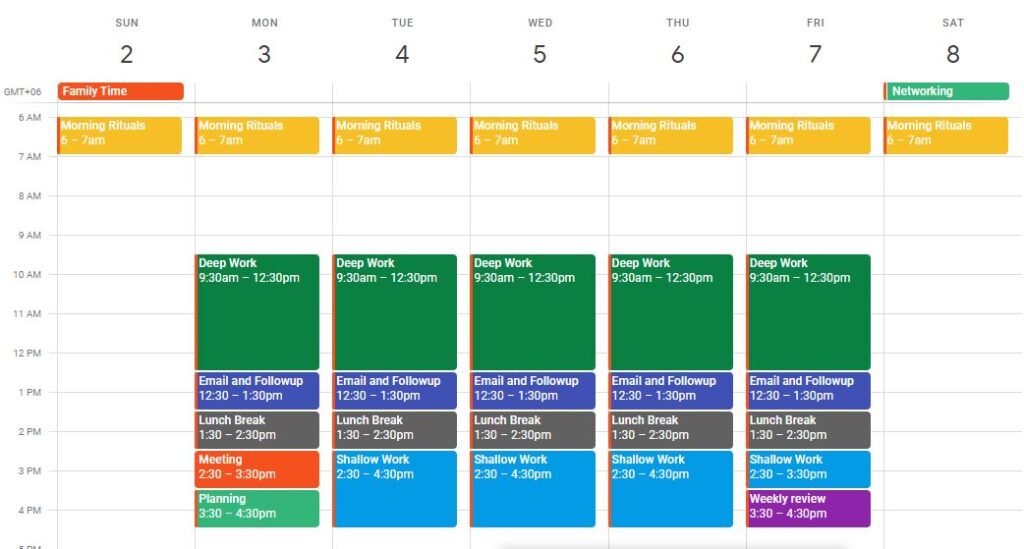
Here’s how to apply the time blocking method in your daily schedule:
- Identify your tasks: Start with your to-do list and decide which activities are most important.
- Create time blocks: Divide your workday into focused segments and assign each task a time period.
Example:- 8:00–10:00 AM: Deep work (writing, planning, or analysis)
- 10:00–10:30 AM: Break
- 10:30–12:00 PM: Meetings or calls
- 1:00–2:00 PM: Admin tasks
- 2:00–4:00 PM: Learning or creative work
- Implement the plan: Treat each time block as a non-negotiable appointment and focus on one task at a time.
- Review and adjust: At the end of the week, evaluate how you spend your time and adjust your time blocks for better results.
The method is ideal for students, professionals, and freelancers who want to bring more structure and focus to their daily routine. By working in well-defined blocks, you’ll spend your time more intentionally, reduce overwhelm, and get more things done in less time.
5. Time Boxing
Time Boxing is one of the most effective time management strategies, which involves setting a fixed amount of time to complete a specific task and stopping once that time runs out.
Unlike Time Blocking, which determines when you’ll work on a task, Time Boxing defines how long you’ll work on it. This structured approach helps you manage your time more intentionally and reduce procrastination.
This popular method is used by productivity experts and companies like Google and IBM to maintain focus and efficiency. It’s especially powerful for people who tend to overthink, overcommit, or struggle to finish tasks on time.
Here’s how to apply the Time Boxing technique:
- Pick a specific task: Choose a focused activity such as writing a report, organizing files, or studying a topic.
- Decide how much time it deserves: Estimate the ideal time, such as 30 or 45 minutes.
- Set a timer: Commit to working only within that box — no distractions or multitasking.
- Stop when the time is up: Even if you haven’t finished, take a short break and review your progress.
- Reassess and plan: If necessary, schedule another time box later in your daily schedule.
For example, you might decide to spend one hour organizing your workspace. When the timer ends, you stop — even if it’s not perfect. This practice encourages you to prioritize important tasks, avoid over-polishing, and focus on progress instead of perfection.
Time boxing creates healthy pressure and structure. It lets you accomplish more in less time. It trains your brain to work efficiently, not endlessly.
This method is particularly effective for professionals, freelancers, and students who struggle with poor time management or perfectionism. When you spend your time in clearly defined boxes, you’ll build consistency, finish projects faster, and feel more in control of your day.
6. Task Batching
Task Batching technique helps you manage your time more efficiently by grouping similar tasks and completing them in one focused session. Instead of switching between different types of work all day — like writing, taking calls, and checking emails — you dedicate specific time slots to each kind of activity.
This method minimizes context switching, which drains mental energy and focus. Research shows that it can take up to 20 minutes to regain focus after switching between tasks. Task Batching eliminates that loss, allowing you to stay in deep focus longer.
How to Implement Task Batching:
- Identify repetitive tasks that you do regularly — such as replying to emails, scheduling posts, or making phone calls.
- Group similar tasks by category. For example:
- Communication tasks: Emails, messages, follow-ups
- Creative tasks: Writing, designing, brainstorming
- Admin tasks: Invoicing, organizing files, planning
- Schedule dedicated time blocks for each batch in your daily schedule. For instance, answer all emails from 10:00–10:30 AM and again from 4:00–4:30 PM.
- Avoid multitasking during a batch. Focus entirely on the assigned type of work.
- Review your workflow weekly to ensure each batch aligns with your priorities and productivity goals.
By batching tasks, you can focus on what truly matters, enter a flow state faster, and stay there longer. This leads to smoother days, fewer mistakes, and more consistent progress toward your goals. You’ll find it easier to prioritize tasks and actually start getting things done.
Task Batching is ideal for individuals who juggle multiple small yet essential tasks throughout the day.
7. The Pomodoro Technique
The Pomodoro Technique is one of the most popular time management techniques for improving focus, building consistency, and reducing burnout. Created by entrepreneur Francesco Cirillo, this method uses a simple timer to break work into focused intervals, usually 25 minutes long, followed by short breaks.
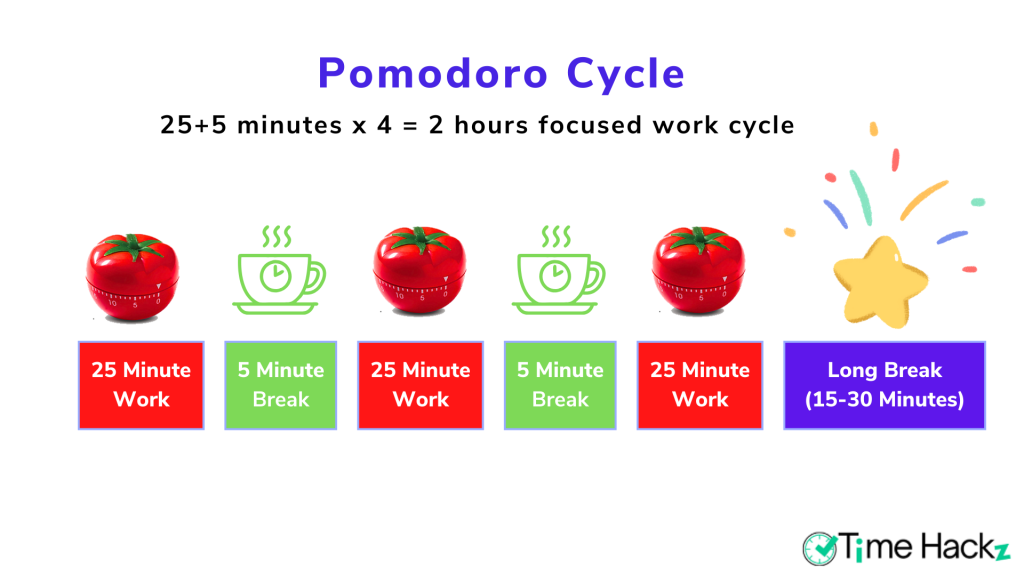
The name Pomodoro (Italian for tomato) comes from the tomato-shaped kitchen timer Cirillo used as a student. This simple yet powerful time management strategy helps you manage your time effectively, maintain concentration, and avoid mental fatigue.
How to Apply the Pomodoro Technique:
- Choose a specific task from your to-do list.
- Set a timer for 25 minutes and work with full concentration on the task at hand.
- Take a short break of 5 minutes once the timer rings.
- After completing four Pomodoros, take a more extended break of 25–30 minutes to recharge.
- Repeat the cycle until your project or daily work session is complete.
The Pomodoro Technique trains your brain to work with the clock rather than against it. It creates a sense of urgency without stress, helping you make better use of each moment. Instead of overworking, you focus on meaningful, result-driven tasks that keep you mentally fresh.
The method is especially beneficial for students, writers, freelancers, and professionals who struggle with distractions or a scattered daily schedule.
8. Parkinson’s Law
Have you ever noticed that when you have a full day to do something simple, it somehow takes the whole day to finish? That’s Parkinson’s Law in action — one of the most powerful yet underrated time management methods.
Coined by British historian C. Northcote Parkinson, the law states: “Work expands to fill the time available for its completion.”
In simple terms, if you give yourself a week to complete a two-hour task, it will feel like a week-long project. This principle explains why many people struggle with procrastination, as excessive time often results in insufficient progress.
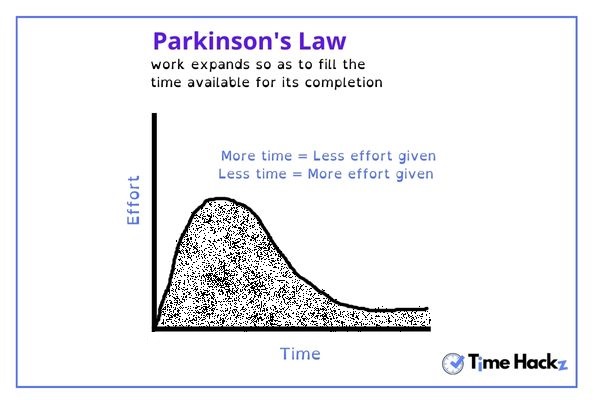
How to Use Parkinson’s Law to Boost Productivity and Efficiency:
- Set shorter deadlines: If you think a task will take 3 hours, give yourself 2. A shorter timeframe creates a sense of urgency and helps you stay focused. This trick can double your efficiency and prevent wasted time.
- Use mini-challenges: Turn work into a productivity game — for example, “Can I finish this blog outline in 45 minutes?” These small challenges make work enjoyable and help maintain high motivation and focus.
- Combine with time boxing: Pair Parkinson’s Law with time boxing, another popular time management technique. Estimate the time and allocate a fixed time box (like 30 or 60 minutes) for each task. When time’s up, stop and move on. This prevents perfectionism and overthinking.
- Batch similar tasks: When you set a specific time period for tasks like checking emails or handling admin work, you’ll naturally work faster and avoid constant context switching — a major productivity killer.
By intentionally limiting your available time, you create healthy pressure that drives focus, discipline, and faster results. It’s beneficial for procrastinators who delay tasks until the last minute and perfectionists who over-refine every detail.
9. Getting Things Done (GTD)
Getting Things Done (GTD) is a famous time management system developed by David Allen, author of the bestseller Getting Things Done: The Art of Stress-Free Productivity.
The system focuses on organizing tasks clearly so your mind stays calm, focused, and free from constant mental clutter. As Allen says, “Your mind is for having ideas, not holding them.”
When you capture and organize your tasks effectively, you reduce overwhelm, eliminate mental noise, and create space for meaningful work and focused productivity.
How to Use the GTD Method Step-by-Step:
- Capture everything: Write down all your tasks, ideas, and commitments in one place — whether in a notebook, app, or digital planner. Capturing helps clear your mind and improves focus.
- Clarify each item: Ask yourself, “What’s the next action?” For instance, instead of writing “Plan trip,” clarify it as “Book flight tickets.” This boosts clarity and keeps you moving forward.
- Organize your tasks: Sort your to-dos into different categories like Work, Personal, Errands, or Calls. Use folders, lists, or project boards to give everything a logical place. This improves task organization and time efficiency.
- Review regularly: Conduct a weekly review to check what’s done, update priorities, and refocus on what matters most. Regular reflection keeps your system running smoothly.
- Engage and take action: Work on one task at a time based on your context — location, time available, or energy level. This eliminates confusion and helps maintain steady productivity throughout the day.
The GTD productivity method gives structure to chaos. By turning random thoughts into clear, actionable steps, you can regain control of your schedule and your peace of mind. In this way, you can turn a simple to-do list into an actionable workflow system.
It’s ideal for professionals, entrepreneurs, or anyone juggling multiple responsibilities. If you often feel mentally scattered or overloaded with tasks, GTD helps you regain focus and direction.
Pro tip: Boost your productivity by combining GTD with other time management techniques like Time Blocking or the Eisenhower Matrix.
For example:
- Use GTD to capture and clarify tasks.
- Then, schedule them using time blocks or prioritize using the Eisenhower Matrix.
This integrated approach ensures you not only capture everything but also act efficiently — maximizing your productivity and focus.
Conclusion
Mastering your time doesn’t require complicated tools — just consistency with the right time management methods. By applying these nine simple techniques, you’ll learn to prioritize effectively, focus better, and accomplish more in less time.
Small habits can create massive improvements in your productivity and efficiency over time.
Start with one or two methods that resonate with you — whether it’s GTD, Pomodoro, or Time Blocking — and practice them for a week.
You’ll soon discover that better time management leads to less stress, more focus, and a greater sense of control over your life.