The Ivy Lee Method: The 100-Year-Old Daily Routine for Laser-Focused Productivity
The Ivy Lee Method is a deceptively simple productivity system that has stood the test of time for over a century. At its core, it asks you to do one thing each evening: write down the six most important tasks you need to accomplish tomorrow, rank them by true importance, and then work through them one task at a time the following day.
At TimeHackz, we’re always searching for practical, low-friction methods that busy professionals, students, and parents can actually stick with. The Lee Method is one of the simplest productivity systems you can try tonight—no apps to download, no complex frameworks to learn, no hours debating which quadrants based priority system to adopt.
Here’s what this guide will cover:
- The fascinating origin story behind the $25,000 productivity lesson
- Exactly how to implement the method in six clear steps
- Why imposing limits on your daily task list reduces decision fatigue and boosts focus
- How to choose and prioritize your six important tasks effectively
- Modern ways to adapt this century-old process to digital tools
- Who benefits most (and when the method might not fit)
- Common mistakes that sabotage the system and how to fix them
By the end, you’ll have everything you need to begin tonight.
The Origin Story: Ivy Lee, Charles Schwab, and the $25,000 Productivity Lesson
It was 1918, and Charles Schwab had a problem. As president of Bethlehem Steel Corporation—one of the largest shipbuilding and steel production companies in the world—he was drowning in the post-World War I industrial boom. His executive team was overwhelmed, and he needed a way to boost their effectiveness without adding more complexity to their already chaotic days.
Enter Ivy Ledbetter Lee.
Lee wasn’t your typical productivity consultant. Born in 1877, he had built a reputation as one of the founding fathers of modern public relations. He’d worked with steel companies, automotive manufacturers, banks, and even governments. He issued the first-ever press release after the 1906 Atlantic City train wreck and pioneered internal company magazines and stockholder reports.
When Schwab asked Lee for help, Lee made an unusual offer.
“Give me 15 minutes with each of your executives,” Lee replied. “Try my method for three months. Then send me a check for whatever you think it was worth.”
Lee spent just 15 minutes with the management team, teaching them a simple daily routine. No elaborate system. No thick manual. Just a straightforward process anyone could follow.
Three months later, Schwab sent Lee a check for $25,000.
Adjusted for inflation, that’s roughly $400,000 to $500,000 in today’s dollars—for a 15-minute productivity lesson.
The moral? Sometimes the most effective method isn’t the most complicated one. For overloaded decision-makers juggling multiple tasks, a deceptively simple routine can outperform every sophisticated productivity system on the market.
How the Ivy Lee Method Works (Step-by-Step)
The Ivy Lee Method is essentially a structured daily to do list limited to six items, tackled in strict sequential order. That’s it. No categories, no color coding, no elaborate tagging systems.
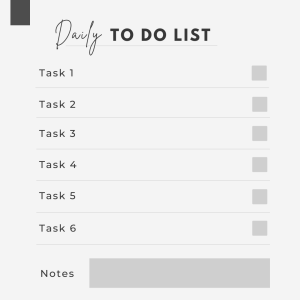
Here’s exactly how to implement it:
Step 1: At the end of your work day, write down the six most important tasks you need to accomplish tomorrow.
This happens every evening, not in the morning. Write down the six most important things—no more than six. If you can only think of four tasks, that’s fine. But never exceed six.
Step 2: Rank those six tasks in order of true importance.
Number them 1 through 6, with #1 being the most critical. Don’t rank by urgency alone or by what feels easiest. Rank by impact. Which one task, if completed, would move your most important work forward?
Step 3: The next day, start with task #1 and work on it exclusively.
When you begin your work day, start writing immediately on your first task. Don’t check email first. Don’t handle “quick” requests. Focus on the most important task until it’s complete or reaches a clear stopping point.
Step 4: Move to task #2 only after completing #1.
Continue working down the list in order. No jumping to task #4 because it seems more interesting. No multitasking. One task at a time, in sequence.
Step 5: Transfer unfinished tasks to tomorrow’s list.
At day’s end, move any unfinished items to the top of the following day’s list. Fill the remaining slots with new tasks from your backlog. Then repeat this process every single day.
Step 6: Repeat this process every evening.
The cycle closes with your nightly planning session. Review your progress, adapt your priorities, and prepare your list for the next day.
The two non-negotiables that make this method work:
- The six-item limit (forces ruthless prioritization)
- Single-task focus (no multitasking or task-hopping)
Why the Ivy Lee Method Works So Well (Psychology and Productivity Principles)
The power of the Ivy Lee Method comes from three psychological principles: constraints, clarity, and reduced decision fatigue.
Evening Planning Eliminates Morning Decision Fatigue
When you decide tomorrow’s priorities the night before, you wake up with a clear roadmap. You don’t spend three or four hours debating what to work on. You don’t waste your peak mental energy making tough decisions about task selection. You simply start with task #1.
This is critical because willpower and decision-making capacity are limited resources. Every choice you make depletes them. By front-loading your planning to the evening, you reduce decision fatigue when it matters most.
The Six-Task Limit Forces Trade-Offs
Most people’s to-do lists are aspirational fantasies. They contain 15, 20, or 30 items that could never fit into a given day.
The Ivy Lee Method forces you to choose a relatively small number of important things. This constraint is the feature, not a bug. When you can only pick six important tasks, you must distinguish between what feels productive and what actually moves your work forward.
Single-Tasking Protects Your Focus
Research consistently shows that multitasking doesn’t work. Switching between multiple tasks reduces efficiency, increases error rates, and can even temporarily lower IQ according to some studies.
The Ivy Lee Method counters this by demanding you stay focused on one task at a time. You work on the current one until it’s done, then—and only then—move to the next task. This creates momentum. Completing the first task naturally propels you into the second.
Simplicity Beats Complexity
Complex productivity systems fail because they require too much maintenance. The Ivy Lee Method takes about 10-15 minutes each evening. That’s it. No app syncing, no weekly reviews that take hours, no elaborate project hierarchies.
For people who have tried and abandoned sophisticated systems, this simplicity is liberating.
Carryover Creates Continuity, Not Failure
When unfinished tasks roll to the next day, they don’t disappear into a backlog graveyard. They get priority placement. This creates progress over time rather than the guilt spiral that comes from watching items languish on traditional to-do lists for weeks.
How to Choose and Prioritize Your Six Tasks
The Ivy Lee Method only works if your six tasks are truly meaningful. Fill your list with easy busywork, and you’ll feel productive while accomplishing nothing of importance.
Avoid the “Fake Productivity” Trap
A weak list looks like this:
- Check email
- Respond to Slack messages
- Schedule meeting
- Review document
- Quick call with vendor
- File expense report
These are activities, not outcomes. They keep you busy but don’t advance your most important projects.
Use the Eisenhower Matrix to Filter
The Eisenhower Matrix divides tasks into four quadrants based on urgency and importance:
| Urgent | Not Urgent | |
|---|---|---|
| Important | Do first | Schedule for focused time |
| Not Important | Delegate if possible | Eliminate |
Most people fill their days with urgent-but-not-important tasks. The Ivy Lee Method works best when you prioritize important but non urgent work—the projects that build your career, health, relationships, or business over time.
Try the 1-2-3 Pattern
Instead of picking six equally sized tasks, structure your list like this:
- 1 big task (90+ minutes of deep work)
- 2 medium tasks (30-60 minutes each)
- 3 small tasks (15-30 minutes each)
This balances ambition with feasibility. You’re not setting yourself up for failure with six massive projects, but you’re also not wasting your day on trivial work.
Include at Least One Goal-Connected Task Daily
Whatever your most important project is—your thesis, a client proposal, your side business, a health habit—put at least one task related to it on your list every single day. Consistent small progress beats sporadic heroic efforts.
Example of a strong six-task list for a remote worker:
- Draft proposal for new client (big task)
- Finish quarterly report section 3 (medium)
- Outline presentation for Friday meeting (medium)
- Schedule dentist appointment (small)
- Review and approve team member’s document (small)
- Send follow-up email to vendor (small)
Example for a college student:
- Write 800 words of research paper (big)
- Complete problem set for statistics (medium)
- Review notes for tomorrow’s exam (medium)
- Email professor about office hours (small)
- Return library books (small)
- Register for next semester courses (small)
Modern Ways to Use the Ivy Lee Method (Paper, Apps, and Routines)
The original method used nothing more than pen and paper. It still works that way—but it also adapts beautifully to modern tools and lifestyles.
The Classic Paper Setup
Grab a notebook or index card. At the top, write tomorrow’s date. Number lines 1-6 down the page. Leave enough space beside each to check items off.
Some people prefer a dedicated “Ivy Lee notebook” they keep on their desk. Others use a fresh index card each day and discard it once complete. The tactile experience of crossing off completed tasks can be surprisingly motivating.
Digital Implementation
If you prefer apps, the method translates easily:
Todoist: Create a “Today: Ivy Lee” project. Each evening, move exactly six tasks into it and use the priority flags (P1, P2, etc.) to establish your ranking.
Notion: Build a simple database with a “Today’s 6” view that filters to your daily priority list. Drag tasks into ranked order.
Apple Notes or Google Keep: Create a new note each evening titled with tomorrow’s date. Number your six tasks.
The key is keeping the interface minimal. Don’t let the tool’s complexity undermine the method’s simplicity.
Pair It With Weekly Planning
Maintain a larger weekly backlog list of everything you want to accomplish. Each evening, pull your next day’s six from this list. This prevents the “what should I even work on?” paralysis.
Set a Nightly Planning Ritual
Choose a consistent time—perhaps 9:30 PM or right before you close your laptop for the day. Spend 10-15 minutes selecting and ranking tomorrow’s list, then mentally close the work day.
James Clear, author of Atomic Habits, has praised the Ivy Lee Method specifically for this 15-minute daily routine that generates peak performance without elaborate systems.
Combine With Time Blocking
For extra power, schedule your top three tasks into specific calendar blocks, ideally during morning hours when energy is highest. Tasks #4-6 can fill afternoon slots or flex time.
Sample daily setup for a freelancer:
- 8:00 PM previous evening: Select and rank tomorrow’s six tasks
- 8:00 AM: Begin task #1 immediately (blocked until 10:00 AM)
- 10:00 AM: Task #2 (blocked until 11:30 AM)
- 11:30 AM: Task #3 (blocked until 12:30 PM)
- 2:00 PM: Tasks #4-6 and any overflow

Who the Ivy Lee Method Is Best For (and When It Might Not Fit)
No productivity method is universal. The Ivy Lee Method shines in specific situations and struggles in others.
Ideal Users
Knowledge workers with project-based tasks: Writers, designers, developers, analysts, and managers who need extended focus time to produce meaningful work.
Students: The method helps prioritize studying, writing, and assignments amid the chaos of classes, social life, and part-time jobs.
Freelancers and entrepreneurs: When you’re responsible for everything, the six-task limit prevents overwhelm and ensures you make progress on what matters.
Busy parents: Juggling work and home responsibilities becomes more manageable when you’ve identified your six non-negotiable priorities for the day.
People overwhelmed by long to-do lists: If your current system involves a 30-item list that makes you anxious just looking at it, Ivy Lee offers immediate relief.
Chronic procrastinators: The single-task focus and pre-decided priorities remove the “what should I work on?” excuse that often masks procrastination.
When It Might Not Fit
Highly reactive roles: Emergency responders, customer support staff handling constant tickets, or executives with back-to-back meetings may find the rigid structure frustrating.
Team-dependent work: The original method is designed for individual execution. If your tasks depend heavily on others’ availability, you may need more flexibility.
People who find six too restrictive: Some users feel constrained. One workaround: treat the six tasks as your “protected priority work” and maintain a separate list for routine chores like email and admin.
The 7-10 Day Test
Before deciding the method doesn’t work for you, commit to a proper trial. Use it consistently for at least 7-10 days, tracking how many important tasks you complete compared to your usual approach. Most people report noticeable productivity gains and reduced stress within the first week.
Common Mistakes and How to Fix Them
The Ivy Lee Method looks simple on paper. That simplicity can be deceptive. Here are the most common ways people sabotage themselves—and how to course-correct.
Mistake #1: Filling the List With Low-Impact Tasks
The problem: You pick six easy tasks to guarantee you’ll check everything off. But you finish the day having accomplished nothing meaningful.
The fix: Before adding a task to your list, ask: “If this is the only thing I complete tomorrow, will I be satisfied?” At least three of your six should pass this test.
Mistake #2: Overstuffing Beyond Six
The problem: You list six tasks but mentally treat email, meetings, and “quick favors” as hidden extras. By noon, your focus is shattered.
The fix: The six-task limit includes everything you’re treating as a priority. If something needs to get done, it takes one of your six slots—or it waits.
Mistake #3: Poor Time Estimation
The problem: You choose six huge projects that would each take a full day. You finish one, feel like a failure, and abandon the system.
The fix: Break big projects into clearly defined actions. Instead of “Write book,” use “Draft 500 words of chapter 2.” Instead of “Prepare taxes,” use “Gather receipts from January-March.”
Mistake #4: Ignoring Energy Patterns
The problem: You schedule your hardest task for 3 PM when your energy is lowest, then wonder why you can’t focus.
The fix: Align tasks #1 and #2 with your peak energy hours. For most people, this means tackling deep work in the morning and saving easier tasks for afternoon slumps.
Mistake #5: Never Reviewing the Pattern
The problem: The same task rolls over day after day, clogging your list and creating guilt.
The fix: Weekly reflection. Once a week, review which tasks repeatedly carry over. Ask: Is this truly a priority? Can I delegate it? Do I need to break it into smaller pieces? Should I just delete it?
| Mistake | Symptom | Quick Fix |
|---|---|---|
| Low-impact tasks | Busy but nothing meaningful done | Apply “only one thing” test |
| Overstuffing | Constant interruptions | Everything counts toward six |
| Poor estimation | Never finish more than 1-2 | Break into 30-90 minute actions |
| Ignoring energy | Struggle with task #1 | Match task difficulty to energy |
| No review | Same items roll over for weeks | Weekly 10-minute reflection |
Putting It All Together: Try the Ivy Lee Method Tonight
The Ivy Lee Method is a century-old, six-task daily planning routine that helps you focus, reduce stress, and make consistent progress on work that actually matters. It takes less time to implement than most people spend scrolling social media before bed.
Your “Tonight” Action Plan
- Grab a notebook or open a notes app. Nothing fancy required.
- Write tomorrow’s date at the top.
- List the six most important tasks you need to accomplish tomorrow. Be specific. Be honest about what’s truly important.
- Rank them 1-6 by true importance. Not by ease. Not by urgency. By impact.
- Set a reminder to start with #1 the moment your work day begins—before email, before Slack, before anything else.
- Repeat this process every evening for at least seven days.
Commit to a Short Trial
Track your results for one week. Note how many meaningful tasks you complete compared to your previous approach. Pay attention to your stress levels and sense of control. Most people notice a difference within days.
Keep Building Your Productivity Toolkit
The Ivy Lee Method is one piece of the puzzle. At TimeHackz, we share practical strategies for time management, procrastination, and stress reduction that complement simple systems like this one.
If you found this guide helpful, consider signing up for our newsletter—you’ll get a free ebook on time management and regular tips to help you live a more focused, fulfilling life.
Small, consistent daily planning rituals like the Ivy Lee Method often create more change over a month than complex productivity systems attempted once and abandoned. You don’t need to overhaul your life tonight.
You just need to write down six tasks, rank them, and start.