
The 12 Week Year: How to Achieve Your Annual Goals in 12 Weeks
By a productivity and time management enthusiast
Think about the last time you set a goal for the year. You were fired up. You wrote it down, maybe even told a friend. Then life happened. A few busy weeks turned into a few busy months, and the goal slid quietly to the bottom of your list.
If that sounds familiar, you are not lazy and you are not alone. The problem is usually not your motivation. It is the time frame you gave yourself.
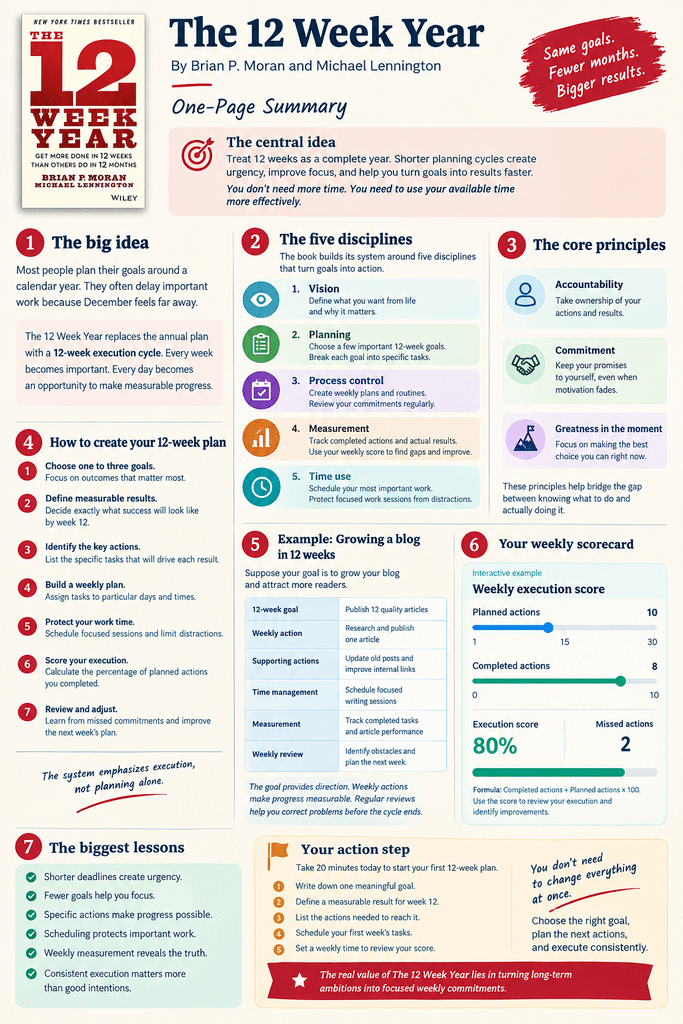
That is the big idea behind the 12 week year, a productivity system from the book The 12 Week Year by Brian P. Moran and Michael Lennington. Instead of planning in 12-month chunks, you treat every 12 weeks as its own “year.” The result is more focus, more urgency, and a much better chance of finishing what you start.
In this guide, you will learn what the 12 week year is, why it works, and exactly how to plan your first 12 weeks, with simple examples you can copy today.
What Is the 12 Week Year?
The 12 week year is an execution system. It takes the usual 12-month planning cycle and shrinks it to 12 weeks, so you work with the urgency of a final stretch all the time.
The authors, Brian P. Moran and Michael Lennington, built the idea around a simple observation: most people and teams already have plenty of good ideas. What they struggle with is carrying those ideas out. Moran is a business leader with decades of experience in sales and management, and the method grew out of helping people close that gap between knowing and doing.
Here is how it works at a glance:
- You set a vision for where you want your life or business to go.
- You choose one to three goals to achieve in the next 12 weeks.
- You break those goals into tactics and a weekly plan.
- You score yourself every week to see if you did what you planned.
- After week 12, you take a 13th week to review, celebrate, and reset.
That 13th week is why many people describe it as a “13-month year”: 12 weeks of focused work, one week to reflect, then repeat.
Why Annual Goals Fail
The authors call the root problem annualized thinking. When you have a whole year to reach a goal, your brain whispers, “There is plenty of time.” So you put things off. The first stretch feels relaxed, the middle gets busy, and the final stretch becomes a panic, if you get there at all.
Example: Say your goal is to write a 40,000-word ebook this year. With 52 weeks on the calendar, writing 800 words a week sounds trivial, so you skip a week, then another. Before long, the “easy” pace has become impossible.
Now compare that with a 12-week goal: write a 10,000-word first draft. Suddenly each week matters. Missing one week means you have lost almost 8% of your timeline. That small shift in perspective changes how you treat every single day.
Annual planning vs. 12 week planning:
- Annual: Lots of time, vague milestones, urgency arrives late.
- 12 week: Short window, clear weekly actions, urgency from day one.
- Annual: Easy to drift and recover later.
- 12 week: Drift shows up within days, so you correct fast.
The Mindset Behind the Method
The system is not just a planner. The authors explain that it rests on three principles, and they are worth understanding before you plan anything.
1. Accountability means ownership
Most people hear “accountability” and think blame or punishment. In the book, it means something more empowering: taking ownership of your actions and results, and asking yourself, “What can I do differently?” instead of “Whose fault is this?”
2. Commitment means keeping promises to yourself
An interest is “I would like to.” A commitment is “I will, even when it is inconvenient.” The book shares a touching story of a man who committed to calling his mother every weekday. That simple promise gave him years of closeness he treasured.
3. Greatness in the moment
This is the idea that you choose the right action before you see any proof it is working. Think of the moment your alarm goes off for a workout you do not feel like doing. Greatness in the moment is getting up anyway.
Expect the emotional dip
Change follows an emotional pattern. You start with excitement (uninformed optimism), hit reality (informed pessimism), and then reach a low point often called the valley of despair. This is where many people quit. The way through is a vision you genuinely care about, plus the weekly structure you will learn below.
The 5 Disciplines of the 12 Week Year
The system works as a closed loop of five disciplines. Use them together:
- Vision: A clear picture of the future that you are emotionally invested in.
- Planning: A written plan with priorities that match your vision.
- Process Control: Tools and routines (like your weekly plan and accountability meeting) that keep daily actions on track.
- Measurement: Lead and lag indicators that give you honest feedback.
- Time Use: Intentional blocks of time that protect your most important work.
Let’s turn these into a plan you can actually follow.
How to Plan Your 12 Weeks: A Step-by-Step Guide
Step 1: Write your vision
Start with the big picture. Where do you want to be in three years? Think about your health, relationships, income, career, and the kind of life you want. A vision gives your 12 weeks a reason to exist, and it is what pulls you through the tough days.
Example vision: “In three years, I run my own freelance design business, earn enough to work four days a week, and have energy left over for my family and fitness.”
Tip: Do not make it too small. A vision that does not excite you will not carry you through the valley of despair.
Step 2: Choose one to three goals for the next 12 weeks
This is where most people go wrong: they pick ten goals. The book recommends keeping your focus tight, with one to three goals. If you are new to the system, start with one or two. Research mentioned in the book suggests that chasing many goals at once tends to discourage people.
Ask yourself: “If I could only achieve one thing in the next 12 weeks to move me toward my vision, what would it be?”
Example goals drawn from the freelance vision:
- Land 3 new paying clients.
- Build a portfolio website with 6 case studies.
Step 3: Make your goals SMART
A goal like “get fit” or “grow my business” is too fuzzy to act on. This is where SMART goal Framework comes in. SMART is a popular framework that makes sure your goal is clear and trackable:
- S: Specific. Say exactly what you want.
- M: Measurable. Attach a number so you know when you have hit it.
- A: Achievable. It should stretch you, not break you.
- R: Relevant. It should connect to your bigger vision.
- T: Time-bound. Give it a deadline. With the 12 week year, that deadline is the end of week 12.
Before and after:
- Vague: “Get fit.”
- SMART: “Lose 6 kg by the end of week 12 by completing 4 workouts per week and tracking my meals daily.”
- Vague: “Write more.”
- SMART: “Finish a 10,000-word first draft of my ebook by the end of week 12 by writing 850 words per day, 4 days a week.”
The book gives its own five criteria for writing goals and tactics, and they overlap nicely with SMART: make them specific and measurable, state them positively, aim for a realistic stretch, assign clear ownership, and set a time limit. Use whichever checklist you prefer, as long as your goal ends up clear and measurable.
Step 4: Break each goal into tactics
A goal is the destination. Tactics are the actions that get you there. Write down the handful of high-impact actions that will actually move the needle, and note when each one is due.
Example: Goal: Land 3 new paying clients by the end of week 12
- Send 10 personalized outreach emails every week.
- Follow up with 5 past contacts every week.
- Publish 1 helpful post on social media every week.
- Book 2 discovery calls every two weeks.
Keep the list short. The book warns against overextending, because too many tactics lead to overwhelm and a plan you will not follow. Simple beats complicated.
Step 5: Build your weekly plan
Here is where the system comes alive. Each week, you create a weekly plan from your 12-week plan. This is not a long to-do list. It only includes the critical actions for that specific week.
Example weekly plan (freelance goal):
- Send 10 outreach emails
- Follow up with 5 past contacts
- Publish 1 social post
- Work on portfolio case study #1 (one 3-hour block)
- Prepare for 1 discovery call
That is 5 items, clear and doable. Spend about five minutes each day glancing at this plan so it stays in front of you. Writing it down matters: a written plan removes guesswork and makes you far more likely to act.
Step 6: Set your lead and lag indicators
How do you know the plan is working? Track two kinds of numbers:
- Lag indicators are the end results, like “3 new clients signed” or “6 kg lost.” You only see them at the finish line.
- Lead indicators are the actions that produce those results, like “emails sent” or “workouts completed.” You can track these daily or weekly, and you fully control them.
Example (fitness goal):
- Lag indicator: weight, measured every week.
- Lead indicators: workouts completed, meals logged, hours of sleep.
If your lead indicators are strong but the lag indicator is not moving, your plan may need adjusting. If your lead indicators are weak, the problem is execution, not the plan. That distinction saves you from changing a perfectly good plan.
Score Your Week: The 85% Rule
This is the heart of the system. At the end of each week, you give yourself a weekly score:
Score = (tactics completed ÷ tactics planned) × 100
Example: You planned 5 tactics for the week and completed 4. Your score is 4 ÷ 5 = 80%.
The authors found that completing at least 85% of your weekly tactics strongly correlates with reaching your goals. So 85% is the benchmark to aim for, not 100%. Perfection is not the point. Consistency is.
Two things to remember when scoring:
- Be honest. The score is a reality check, not a judgment. It simply tells you whether you did what you said you would do.
- Use the discomfort. The book calls the uncomfortable feeling of falling short “productive tension.” High achievers use it as fuel to improve next week rather than avoiding the number.
A simple way to track it: draw a small table with weeks 1 to 12 across the top, and write your score under each one. Seeing a line of numbers builds momentum and shows you exactly where things slip.
Take Back Control of Your Time with Performance Time
A plan means nothing if your calendar is full of other people’s priorities. One study cited in the book found that the average person wastes about two hours each working day. The fix is intentional time use, which the authors call Performance Time. It has three types of blocks:
Strategic Block
A protected 3-hour block of focused work on your most important tasks. No email, no phone, no interruptions. The book suggests one strategic block per week is a solid start.
Example: Every Tuesday morning, 9:00 to 12:00, you work only on your portfolio case study with your phone in another room.
Buffer Block
A short block, around 30 to 60 minutes, where you handle the small, low-value stuff: emails, calls, quick admin. Batching these tasks stops them from nibbling at your whole day.
Example: Check and answer email twice a day, from 12:30 to 1:00 and from 4:30 to 5:00, instead of every few minutes.
Breakout Block
Scheduled time to rest, recharge, and handle personal matters. Creativity and energy need recovery too, and putting breaks on the calendar makes you more likely to take them.
Example: Friday afternoon is a breakout block for a long walk, errands, or time with family.
Design your ideal week
Sit down with a blank weekly calendar and place your blocks first: strategic, buffer, then breakout. Then fit everything else around them. Seeing your week visually reduces stress and helps you say no to things that do not belong. That is the other half of time management: knowing when to say yes and when to say no.
Your Weekly Routine: 3 Steps That Keep You on Track
Once you are set up, your week follows a simple loop:
- Score your week. Calculate your percentage and note what worked and what did not.
- Plan your week. Create your next weekly plan from your 12-week plan.
- Join a Weekly Accountability Meeting (WAM). A short check-in with a peer or small group.
What is a Weekly Accountability Meeting?
Peer support makes a real difference. The book points to evidence that people with support do far better than people going it alone. A WAM is short, around 15 to 20 minutes, and follows a simple agenda:
- Individual report: Each person shares their score and their plan for the week ahead.
- Successful techniques: Share what worked so others can borrow it.
- Encouragement: Cheer each other on for the coming week.
No team? No problem. Ask a friend, coworker, or online buddy to be your accountability partner. A quick weekly call or message where you each share your score is enough.
Your First 12 Weeks: A Week-by-Week Roadmap
The authors suggest treating the 12 weeks in three phases, plus the bonus week.
Weeks 1 to 4: Build the habits
Focus on getting the basics right: writing your plan, scoring yourself, and attending your accountability check-in. Do not worry about perfection. Early engagement sets the tone for everything else.
Weeks 5 to 8: Fight the motivation dip
The excitement of the start has faded, and this is where many people drift. Look closely at your scores. If your execution is below 85%, find the breakdown. Are you overloading your week? Are the blocks not protected? Adjust and keep going. Lean into the productive tension.
Weeks 9 to 12: Finish strong
No matter how your progress looks, push through to the end. Treat the last weeks like the final stretch of a race. Take decisive action on your most important tactics and see what is still within reach.
Week 13: Review and reset
Step back and reflect:
- What did I achieve?
- What got in the way?
- What will I do differently next time?
- What are my goals for the next 12 weeks?
Celebrate your wins, even small ones, then start your next cycle with fresh energy and a clearer picture of how you work best.
Common Obstacles and How to Beat Them
The book calls the inner barriers to change “resistance.” Here are the most common ones and simple ways to handle them:
- Craving instant comfort. Scrolling feels better than writing right now. Reconnect with your vision and ask, “Which choice moves me toward it?”
- Too many goals. Cut the list down to one to three. Focus creates momentum.
- Old habits. New results require new actions. Replace an old habit with a specific written action, like “After dinner, I write for 30 minutes” instead of “I will find time.”
- Victim thinking. “I have no time” or “my boss will not let me” shifts power away from you. Ask what is within your control, and act on that.
Pros and Cons of the 12 Week Year
No system is perfect, so here is an honest look.
Pros
- Creates urgency and focus quickly.
- Gives you clear weekly actions instead of vague yearly intentions.
- Easy to measure with a simple weekly score.
- Works for individuals, freelancers, and teams.
- The 13th week builds in reflection and a fresh start.
Cons
- It takes discipline: you must plan and score every single week.
- The pace can feel intense if you also have a very full life.
- Some long-term goals need extra thought to fit into 12-week chunks.
- It works best if you commit to the whole system, not just parts of it.
A practical tip for the last point: break big, long-term goals into the part you can achieve in 12 weeks, such as the first milestone of a larger project.
12 Week Year Printable planner
Here is a FREE printable planner on 12 Week Year method and a short note on how to use it.
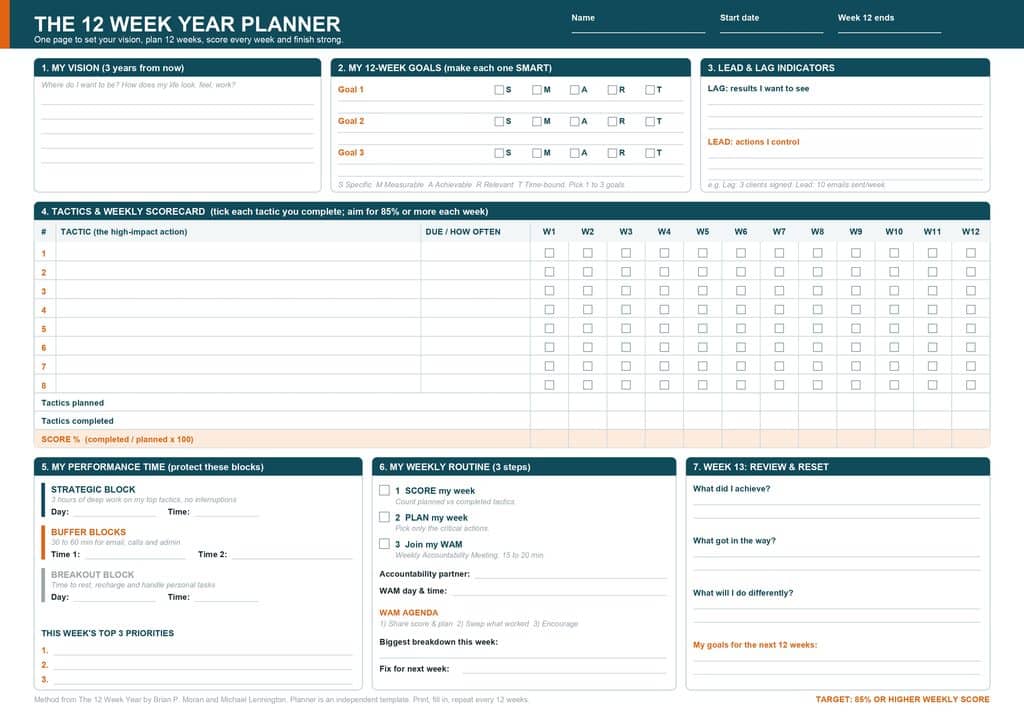
The planner has seven sections:
- My Vision: a three-year picture of where you want to be.
- 12-Week Goals: three goal slots, each with S-M-A-R-T tick boxes so you check every goal against the SMART method.
- Lead & Lag Indicators: space for the results you want and the actions you control.
- Tactics & Weekly Scorecard: eight tactics with tick boxes for weeks 1 to 12, plus rows for planned, completed, and score %. The score row shows the formula (completed / planned x 100).
- Performance Time: your strategic, buffer, and breakout blocks, and top 3 priorities for the week.
- Weekly Routine: score, plan, and join your accountability meeting, with the meeting agenda and a “biggest breakdown / fix” line.
- Week 13 Review & Reset: four reflection prompts.
Frequently Asked Questions
What is the 12 week year in simple terms?
It is a goal-setting and productivity system that replaces the annual plan with a 12-week plan. You pick one to three goals, plan weekly actions, score your progress, and review everything after week 12.
Who wrote The 12 Week Year?
The book was written by Brian P. Moran and Michael Lennington.
Can I start the 12 week year at any time?
Yes. Your 12 weeks begin the day you start, not on a special date. That is one of the best parts: there is no need to wait for a new calendar year or a fresh start. Pick your start day, mark your week 12 end date, and go.
How many goals should I have?
One to three. If you are brand new, start with one or two so you can build the habit of weekly planning and scoring.
What if I miss a week or have a bad score?
Do not quit. Look at what caused the low score, adjust your next weekly plan, and keep going. A single low week is information, not failure.
Is it useful for students, freelancers, and teams?
Yes. The principles apply anywhere you want clearer priorities and better follow-through. A student can use it for study and exam goals, a freelancer for client and income goals, and a manager can run it with a whole team using shared goals and weekly check-ins.
Final Thoughts: Start Your Week 1 Today
The 12 week year is not about working harder. It is about working with clearer priorities, a shorter timeline, and an honest weekly scoreboard. When every week counts, you stop waiting for “someday” and start making steady progress now.
Here is your simple starting checklist:
- Write a vision for where you want to be in three years.
- Pick one to three goals for the next 12 weeks and make them SMART.
- Break each goal into a few high-impact tactics.
- Create your first weekly plan and block out one 3-hour strategic block.
- Find an accountability partner and set a weekly check-in.
- Score yourself at the end of week 1.
Do not wait for the perfect moment. Choose your goal, mark your calendar for 12 weeks from today, and take your first action right now. If you want to go deeper, pick up The 12 Week Year by Brian P. Moran and Michael Lennington and follow the full system.
What will you achieve in your next 12 weeks? Share your goal in the comments, and let’s hold each other accountable.
